

Gary Albert, better known online as the HDMI Guy, is the editor of HDMI RF Modulator, a practical resource for people trying to make old-school video equipment work with modern TVs, displays, and home entertainment systems.
dBmV is one of the more common acronyms you’ll come across when comparing RF modulators, amplifiers, splitters, or coax equipment. Ever wondered what it means? Simply put, dBmV is a way of expressing RF signal strength on a coax cable.
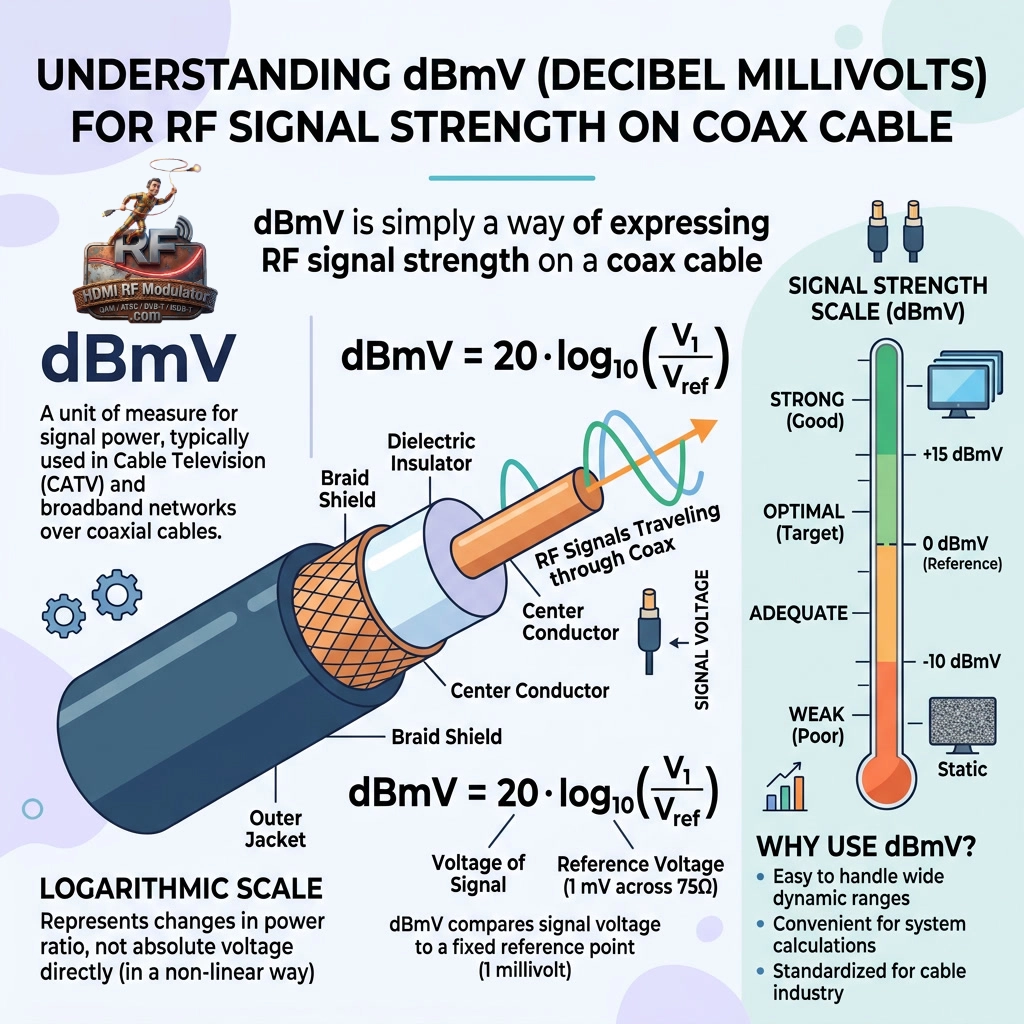
The dB stands for decibels, and mV refers to millivolts. A reading of 0 dBmV corresponds to 1 millivolt across a 75-ohm coaxial system, which is the standard impedance used for television and cable equipment.
You don’t need to memorize the math to use the number effectively. What matters is understanding that higher dBmV means a stronger signal, and every splitter, cable run, connector, and other component can reduce that signal before it reaches the television.
Why dBmV Matters With RF Modulators
Suppose you connect an HDMI-to-RF modulator to one television with a short coax cable. The signal doesn’t have to work very hard. A modest output level may be perfectly adequate.
Now suppose you want that same modulated TV channel to reach eight televisions throughout a large house, restaurant, or hotel. The RF signal might pass through 100 feet of coax and several splitters before reaching the most distant TV.
Every part of that journey introduces some loss. A two-way splitter typically costs you roughly 3.5 dB per output. Four-way and eight-way splitters introduce even greater losses. Long coax runs also reduce signal strength, particularly at higher frequencies.
That is why professional digital modulators often advertise significantly higher RF output levels than inexpensive consumer units.
How Much dBmV is Enough?
There isn’t one magic dBmV number that works for every installation. For a TV receiving an RF signal, you generally want enough level at the TV’s coax input to produce reliable reception without driving the tuner with an unnecessarily strong signal.
As a practical rule of thumb, signals somewhere around 0 to +10 dBmV at the television are usually quite comfortable for many TV distribution applications. Digital television signals can often work well below that, provided the signal is clean and isn’t suffering from interference or excessive noise.
The important number, however, isn’t necessarily the output printed on the modulator’s specification sheet. It’s the signal level after all the cable and splitter losses have occurred.
For example, imagine a modulator outputs +20 dBmV. Your distribution system introduces 12 dB of total loss before the signal reaches a particular television: +20 dBmV – 12 dB = +8 dBmV
That’s a healthy signal level.
Is More dBmV Always Better?
It’s counter-intuitive, but no. While it’s tempting to assume that if +10 dBmV is good, +25 dBmV must be fantastic, RF doesn’t work that way.
An excessively strong signal can overload television tuners, amplifiers, or other equipment and actually make reception worse. The goal isn’t maximum power. It’s enough signal to overcome the losses in your particular coax system while remaining within the operating range of the receiving equipment.
That is also why adjustable RF output is useful on better modulators.
When High Output Really Matters
A high-output modulator becomes valuable when you’re feeding a larger coax network.
A unit capable of around +20 to +24 dBmV gives you substantial headroom for splitter losses, long cable runs, and multiple televisions. You can then attenuate the signal if necessary rather than starting with a weak source and trying to amplify it later.
For one television connected by a 10-foot coax cable, though, you probably don’t need anything close to that. That’s the easiest way to think about dBmV: it’s your RF signal budget. The more cable, splitters, and TVs you have between the modulator and the destination, the more signal you’ll need at the beginning.